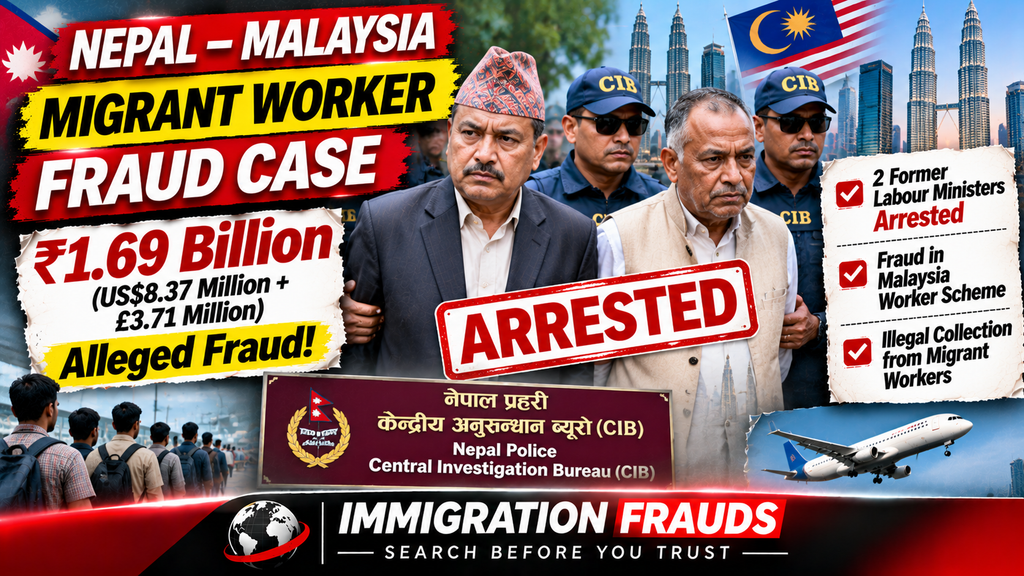
Nepal’s Central Investigation Bureau has arrested two former labour ministers and four senior government officials over allegations that migrant workers travelling to Malaysia were illegally charged additional fees. Investigators say approximately NPR 1.69 billion was collected and transferred abroad in violation of the Nepal–Malaysia labour agreement.
Kathmandu: A major investigation into alleged exploitation of Nepali migrant workers has taken a significant turn after the Central Investigation Bureau (CIB) of Nepal Police arrested two former labour ministers and four former government officials in connection with an alleged organised fraud and foreign currency transfer case involving workers travelling to Malaysia.
The arrested former ministers are Sher Bahadur Kunwar and Rameshwar Raya Yadav, who previously headed the Ministry of Labour, Employment and Social Security. The other four individuals include former ministry secretary Binod KC, former joint secretaries Umesh Dhungana and Rajiv Pokharel, and former under-secretary and legal officer Nirmala Gurung.
According to the CIB, the accused allegedly played roles in decisions that enabled money to be collected from migrant workers in violation of the Memorandum of Understanding (MoU) between the governments of Nepal and Malaysia. The amount under investigation includes approximately US$8.37 million and £3.71 million, together equivalent to around NPR 1.69 billion.
The Nepal Malaysia Migrant Worker Fraud investigation is examining allegations of illegal fee collection, abuse of official authority, failure to protect workers from exploitation and the transfer of funds abroad through decisions that allegedly bypassed established legal procedures.
The arrests were made in Kathmandu, Lalitpur and Sarlahi after the CIB obtained warrants from the Kathmandu District Court. Further investigation is underway.
What Is the Nepal Malaysia Migrant Worker Fraud Case?
The Nepal Malaysia Migrant Worker Fraud case concerns allegations that Nepali workers travelling to Malaysia for employment were made to pay additional amounts in connection with medical examinations and biomedical services.
Under the labour arrangement between Nepal and Malaysia, the recruitment and pre-departure process is governed by agreed procedures. Investigators allege that additional charges were collected from workers beyond the permitted or officially determined fees.
The CIB is examining whether decisions taken by former ministers and senior officials helped facilitate the collection and transfer of these amounts.
The case has become particularly significant because it involves not only alleged private-sector exploitation but also former government officials who held positions of responsibility in the ministry overseeing foreign employment.
The central question is whether official decisions and administrative approvals were used to support a system that placed additional financial burdens on Nepali workers seeking jobs abroad.
Two Former Labour Ministers Among Six Arrested
The CIB arrested six individuals in the latest phase of the investigation.
The arrested former ministers are:
- Sher Bahadur Kunwar, former Minister for Labour, Employment and Social Security.
- Rameshwar Raya Yadav, former Minister for Labour, Employment and Social Security.
The four former officials taken into custody are:
- Binod KC, former secretary of the ministry.
- Umesh Dhungana, former joint secretary and former chief of the Employment Management Division.
- Rajiv Pokharel, former joint secretary and former chief of the Employment Management Division.
- Nirmala Gurung, former under-secretary and legal officer in the Employment Management Division.
According to the CIB, the arrests followed a letter from the Office of the Prime Minister and Council of Ministers and a formal complaint filed by Bikash Ranabhat and others.
The suspects were arrested from different locations in Kathmandu, Lalitpur and Sarlahi, following authorisation from the Kathmandu District Court.
The Nepal Malaysia Migrant Worker Fraud investigation is examining the alleged roles of the former ministers and officials in decisions connected with the collection and transfer of money from workers.
Their arrests do not establish guilt. The allegations will have to be tested through the investigation and judicial process.
NPR 1.69 Billion Allegedly Collected From Migrant Workers
The financial scale of the case is one of its most significant aspects.
According to the CIB figures reported by Radio Nepal and The Annapurna Express, the amount involved is approximately:
- US$8.37 million
- £3.71 million
- Around NPR 1.69 billion in total
A more precise figure reported by Nagarik News is NPR 1,690,224,026.76.
The CIB alleges that the funds were collected from Nepali workers travelling to Malaysia in violation of the bilateral labour understanding and established legal procedures.
Investigators are also examining the alleged transfer of the funds to Malaysia and whether the decisions facilitating the movement of foreign currency exceeded the authority of the officials involved.
The Nepal Malaysia Migrant Worker Fraud case therefore raises two connected concerns: the alleged financial exploitation of workers and the potential impact of the transactions on Nepal’s foreign exchange reserves.
The NPR 1.69 billion figure represents the amount cited in the investigation and reporting. It should not be treated as a final court-established loss or finding of guilt.
Extra Medical and Biomedical Charges Under Investigation
Further reporting by Ratopati has provided additional details about the alleged method used to collect money from workers.
According to that reporting, workers travelling to Malaysia were allegedly charged an additional 100 Malaysian ringgit per person in the name of medical examinations and biomedical services.
The investigation has focused on whether workers were required to undergo additional tests at selected health institutions and pay charges beyond the officially prescribed medical examination fees.
A company identified in the reporting is Macrotech Pvt. Ltd., which allegedly played a key role in the health examination and biometric process for workers travelling to Malaysia.
Investigators are examining whether the arrangement created a system in which workers had to use a limited group of designated health institutions and pay additional charges to complete their employment-related formalities.
These allegations are important because medical examinations are a mandatory part of the overseas employment process. Workers may have little practical choice if they are told that payment for a particular examination or service is necessary before they can proceed with their jobs abroad.
The Nepal Malaysia Migrant Worker Fraud investigation is examining whether the additional charges were lawful, how the collection system operated and who benefited from the money.
Alleged Transfer of Money to Malaysia
The CIB has alleged that the accused were involved in decisions that facilitated the transfer of illegally collected funds to Malaysia.
The investigation concerns approximately US$8.37 million and £3.71 million, together equivalent to around NPR 1.69 billion.
According to further reporting by Ratopati, a substantial portion of the money collected in Nepal was allegedly transferred to a Malaysian company called Bestinet through financial channels.
The report also described the alleged involvement of Macrotech Pvt. Ltd. in the collection process and stated that investigators were examining the movement of the funds through banking channels.
These details form part of the wider investigation and should be distinguished from final judicial findings. The CIB will need to establish the transactions, the authority under which they were approved and the responsibilities of each person involved.
The alleged foreign currency transfers have made the Nepal Malaysia Migrant Worker Fraud case an issue extending beyond recruitment fees and medical charges. It also involves questions about compliance with foreign exchange rules and the management of funds collected from migrant workers.
Allegations of Abuse of Authority and Failure to Protect Workers
The former ministers and officials are accused of exceeding their official authority and participating in decisions that allegedly facilitated the collection and transfer of money.
The CIB has also alleged that the officials failed to take appropriate legal action against the exploitation of workers and were involved in decision-making connected with sending the collected funds to Malaysia.
These allegations raise questions about the responsibilities of government officials in protecting citizens who travel abroad for employment.
The Ministry of Labour, Employment and Social Security plays an important role in overseeing foreign employment policies and safeguarding migrant workers’ interests. Decisions affecting recruitment costs, medical requirements and pre-departure procedures can have direct financial consequences for people seeking work overseas.
If the allegations are established, the case could expose serious weaknesses in oversight and accountability within the foreign employment system.
However, the precise responsibility of each accused person remains a matter for investigators and the courts.
How the Investigation Began
According to the CIB, the investigation was initiated following a directive from the Office of the Prime Minister and Council of Ministers and a formal complaint filed by Bikash Ranabhat and others.
The bureau obtained arrest warrants from the Kathmandu District Court before carrying out the arrests in Kathmandu, Lalitpur and Sarlahi.
The case is being investigated under the Fraudulent Offense and Organized Crime Prevention Act, 2070, according to the information provided by the CIB.
The bureau’s spokesperson, Senior Superintendent of Police Anupam Shamsher JBR, confirmed that further investigation is underway.
The Nepal Malaysia Migrant Worker Fraud investigation is expected to examine the decisions taken by the former officials, the financial records associated with the alleged collections and the movement of the funds abroad.
Earlier Arrests and a Wider Investigation Into the Medical Fee System
The latest arrests are part of a broader investigation into alleged irregularities in the medical screening and recruitment process for Nepali workers travelling to Malaysia.
Earlier reporting by Ratopati stated that the CIB had arrested other individuals in October in connection with the alleged collection of additional biomedical service fees.
Those earlier arrests reportedly included Kailash Khadka, along with Rabindra KC, Pravin Tiwari and Ram Pukar Tiwari.
The investigation has therefore expanded beyond the former ministers and ministry officials to examine the people and organisations allegedly involved in operating the medical screening and fee collection arrangements.
The exact legal responsibility of each individual and the relationship between the different parts of the alleged system remain subject to investigation.
The wider probe could help establish how the additional charges were introduced, how the money was collected, where it was transferred and whether the relevant government approvals complied with the Nepal–Malaysia labour agreement.
What the Case Means for Nepali Migrant Workers
The Nepal Malaysia Migrant Worker Fraud case has renewed concerns about the financial risks faced by people who seek overseas employment.
For many Nepali families, working abroad is an important source of income. However, the process can involve recruitment expenses, medical examinations, documentation, travel arrangements and other pre-departure requirements.
When additional charges are imposed outside the permitted framework, workers may have little choice but to pay if they fear losing their employment opportunity.
The allegations in this case underline the importance of transparency in every stage of overseas recruitment.
Migrant workers should take the following precautions:
- Check official fee requirements: Verify the permitted charges for medical examinations and recruitment-related services.
- Demand receipts: Obtain a written receipt for every payment made to a recruitment agency, medical institution or intermediary.
- Verify designated medical centres: Confirm that the health institution is authorised for the relevant overseas employment process.
- Question unexplained additional charges: Ask for the legal basis and official schedule for any extra fee.
- Keep employment documents: Preserve job agreements, medical reports, receipts and all recruitment-related correspondence.
- Report suspected exploitation: Approach the relevant government authorities if a recruiter or service provider demands unauthorised payments.
The case also highlights why government oversight is essential. Workers should not have to bear unexplained costs simply to complete mandatory procedures before leaving their country for employment.
Investigation Continues as Questions Remain Over NPR 1.69 Billion
The arrest of two former labour ministers and four former officials marks a major development in the Nepal Malaysia Migrant Worker Fraud case.
Investigators are examining the alleged illegal collection of money from workers, the decisions taken by government officials, the role of companies involved in the medical screening process and the transfer of funds to Malaysia.
The key questions include whether the additional charges were authorised, who benefited from the collections, how the money was transferred and whether officials knowingly facilitated decisions that violated the bilateral labour agreement.
The case could have significant implications for the regulation of overseas employment and the protection of Nepali migrant workers.
For now, the CIB has confirmed that further investigation is underway. The six arrested individuals remain accused, and the allegations must be established through the legal process.
FAQs : Nepal Malaysia Migrant Worker Fraud
What is the Nepal Malaysia Migrant Worker Fraud case?
The Nepal Malaysia Migrant Worker Fraud case concerns allegations that Nepali workers travelling to Malaysia were illegally charged additional fees, including amounts linked to medical examinations and biomedical services. The CIB is investigating the alleged collection and transfer of approximately NPR 1.69 billion.
Which former ministers have been arrested in the Nepal Malaysia Migrant Worker Fraud case?
The arrested former labour ministers are Sher Bahadur Kunwar and Rameshwar Raya Yadav.
How many people were arrested in the latest CIB operation?
Six people were arrested in the latest operation: two former ministers and four former government officials.
Who are the four former officials arrested in Nepal Malaysia Migrant Worker Fraud?
The four officials are former ministry secretary Binod KC, former joint secretaries Umesh Dhungana and Rajiv Pokharel, and former under-secretary and legal officer Nirmala Gurung.
How much money is involved in the alleged Nepal Malaysia Migrant Worker Fraud ?
The CIB has cited approximately US$8.37 million and £3.71 million, together equivalent to around NPR 1.69 billion.
Why were migrant workers allegedly charged extra fees?
According to additional reporting, workers travelling to Malaysia were allegedly charged an extra 100 Malaysian ringgit per person for medical examinations and biomedical services beyond the officially prescribed charges.
Which companies have been mentioned in the Nepal Malaysia Migrant Worker Fraud investigation?
Additional reporting has identified Macrotech Pvt. Ltd. in connection with the medical screening and biometric process and Bestinet in connection with the alleged transfer of funds to Malaysia. Their roles and any legal responsibility remain subject to investigation.
Where were the six accused arrested in Nepal Malaysia Migrant Worker Fraud?
The CIB said the arrests were made at different locations in Kathmandu, Lalitpur and Sarlahi, following warrants from the Kathmandu District Court.
Which law is being used in the investigation?
The CIB has stated that the investigation is being conducted under the Fraudulent Offense and Organized Crime Prevention Act, 2070.
Is the Nepal Malaysia Migrant Worker Fraud case investigation complete?
No. The CIB has confirmed that further investigation is underway. The allegations against the arrested individuals have not been established as final judicial findings.
Source : Nepal News
Read About : Sonbhadra Overseas Job Cyber Fraud: ₹100 Crore Racket Busted as Police Arrest Alleged Mastermind