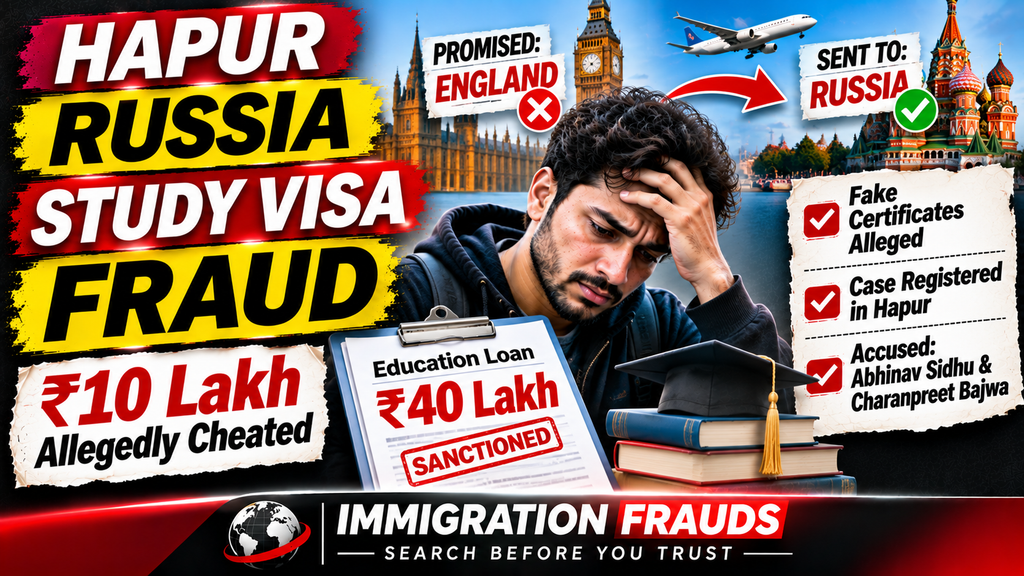
A shocking Hapur Russia study visa fraud case has come to light in Uttar Pradesh, where a young man allegedly lost ₹10 lakh after being promised admission and a study visa for England, only to be sent to Russia on a tourist visa. The allegations go beyond financial cheating: the accused reportedly arranged an education loan of approximately ₹40 lakh in the victim’s name, allegedly manipulated his academic documents and created bank and email accounts that were operated by others.
The victim, identified as Satyam Singh, a resident of village Gandun Nagla in the Garhmukteshwar tehsil area of Hapur, claims that his father is now facing monthly loan instalment deductions of approximately ₹5,000 from his bank account. He also alleges that fake Class 10, Class 12 and graduation marksheets were prepared in his name.
The case involves two named individuals, Abhinav Sidhu and Charanpreet Bajwa, along with other people whose alleged involvement is being investigated.
According to a report published by Dainik Jagran on November 18, 2026, police have registered a case following the victim’s complaint and initiated an investigation.
The Hapur Russia study visa fraud allegations raise serious concerns about overseas education consultancy practices, misuse of personal documents, unauthorised financial transactions and the risks faced by students seeking admission to foreign universities.
Hapur Russia Study Visa Fraud: England Study Visa Promised for ₹16 Lakh
According to the complaint, the incident began in December 2024 when Satyam Singh met Abhinav Sidhu, a resident of village Akaduli in the Hafizpur police station area of Hapur.
Abhinav Sidhu allegedly offered to arrange a study visa for England, claiming that the entire process would cost approximately ₹16 lakh.
The promise of studying abroad and building a better future convinced Satyam Singh to proceed with the arrangement.
Trusting the assurances, he reportedly paid ₹10 lakh through a relative and handed over several important personal documents.
These included:
- Passport
- Aadhaar card
- PAN card
- Class 10 marksheet
- Class 12 marksheet
- Other educational and personal documents
The victim allegedly believed that the remaining formalities would be completed and that he would soon be able to travel to England for higher education.
However, according to his complaint, the process continued to be delayed for several months.
Instead of receiving the promised English study visa, he was eventually offered a different travel arrangement.
Instead of England, Youth Allegedly Sent to Russia on a Tourist Visa
One of the most concerning allegations in the Hapur Russia study visa fraud case is that Satyam Singh was allegedly sent to Russia instead of England.
According to the complaint, after repeatedly delaying the original arrangement, Abhinav Sidhu allegedly arranged a Russian tourist visa.
The victim was reportedly assured that he would be sent to England from Russia after reaching the country.
Believing these assurances, Satyam Singh travelled to Russia.
However, after reaching there, he reportedly became suspicious of the arrangement and began questioning the promises made to him.
He allegedly realised that the travel arrangement was not matching the original agreement for higher education in England.
Concerned about the situation, he decided to return to India at his own expense.
The complaint does not specify the exact dates of his departure from or return from Russia, nor does it identify the institution where he was supposedly expected to study.
The central allegation is that a tourist visa for Russia was arranged under the pretext of sending him to England for higher education.
₹40 Lakh Education Loan Allegedly Sanctioned Through Credila Finance
The financial dimension of the Hapur Russia study visa fraud case became even more serious after an education loan of approximately ₹40 lakh was reportedly sanctioned in the victim’s name.
According to Satyam Singh’s complaint, even after he returned from Russia, the accused allegedly continued assuring him that he would be sent to England.
During this period, an education loan of approximately ₹40 lakh was reportedly arranged through Credila Finance Limited.
The loan was allegedly processed using the victim’s personal and educational documents.
However, Satyam Singh claims that he did not have proper control over important parts of the loan-related banking and communication arrangements.
The alleged loan-related irregularities are among the most serious aspects of the complaint because the financial liability is reportedly connected to the victim and his family.
It is important to distinguish between the amounts involved:
- ₹10 lakh was allegedly paid to the intermediary for the promised overseas study arrangement.
- Approximately ₹40 lakh was reportedly sanctioned as an education loan in the victim’s name.
- The loan amount should not be treated as an additional ₹40 lakh confirmed payment received by the accused.
The investigation will need to establish how the loan was processed, where the money was disbursed and who ultimately controlled the funds.
Victim’s Mobile Number Allegedly Replaced During HSBC Bank Account Opening
Another major allegation concerns the opening and operation of a bank account in the victim’s name.
According to the complaint, an account was opened in Satyam Singh’s name at HSBC Bank during the education loan process.
However, he alleges that instead of registering his own mobile number, the accused allegedly used their own mobile number for the account.
An email address was also reportedly created in his name, but the victim claims that the accused operated it themselves.
If established, these allegations could raise serious questions about the handling of personal information, banking access and financial consent during the loan process.
The complaint further states that the victim’s father is now facing monthly deductions of approximately ₹5,000 from his bank account towards the education loan instalments.
This has reportedly created an ongoing financial burden for the family.
The investigation will need to establish:
- Who opened the bank account?
- Who provided the mobile number linked to the account?
- Who controlled the email address?
- Who accessed the loan-related communications?
- Where was the education loan amount transferred?
- On what basis were repayments linked to the father’s bank account?
These details could be crucial in determining whether the loan process involved unauthorised activity.
₹8 Lakh Deposited for England Tuition Fees, ₹1.70 Lakh Still Outstanding
The complaint also names Charanpreet Bajwa, a resident of Rudrapur in Udham Singh Nagar, Uttarakhand, as an alleged participant in the arrangement.
According to Satyam Singh, an account was opened through Utkarsh Small Finance Bank, and approximately ₹8 lakh was deposited in the name of tuition fees for studying in England.
The victim claims that ₹6.30 lakh was subsequently returned, while approximately ₹1.70 lakh remains outstanding.
The reported financial position is:
| Particulars | Amount |
|---|---|
| Amount deposited for tuition fees | ₹8 lakh |
| Amount reportedly returned | ₹6.30 lakh |
| Amount reportedly outstanding | ₹1.70 lakh |
The complaint does not establish the complete transaction trail or explain the precise destination of every payment.
However, the victim alleges that the tuition-fee arrangement was part of the wider promise of securing admission and a study visa for England.
The outstanding ₹1.70 lakh is a separate reported financial issue and should not be confused with the ₹10 lakh allegedly paid to the intermediary or the ₹40 lakh education loan.
Fake Class 10, Class 12 and Graduation Marksheets Allegedly Prepared
One of the most serious allegations in the Hapur Russia study visa fraud case concerns the preparation of fake academic documents.
According to the complaint, Satyam Singh later discovered that fabricated educational marksheets had allegedly been prepared in his name.
These reportedly included:
- Class 10 marksheet
- Class 12 marksheet
- Graduation marksheet
The alleged preparation of fake academic certificates raises important questions about how the documents were created and whether they were used in the education loan or overseas admission process.
Genuine academic records are essential for international university admissions and student visa applications.
If fabricated certificates were submitted without the applicant’s knowledge, the individual could face serious complications when their academic credentials are verified.
The police investigation will need to establish who prepared the alleged documents, who authorised their use and whether they were submitted to any university, financial institution or immigration authority.
The complaint does not establish that any particular foreign university or immigration department accepted these allegedly fabricated documents.
Previous Complaint, Alleged Settlement and Death Threats
According to Satyam Singh, he had initially approached the Superintendent of Police, Hapur, with a complaint regarding the alleged fraud.
The matter was subsequently examined by the Cyber Crime Branch.
The victim claims that during the investigation, a settlement was reached and Charanpreet Bajwa admitted to the alleged fraud.
However, according to his account, Abhinav Sidhu did not return the money.
The victim further alleges that when he demanded the return of his money and sought resolution of the financial problems, he began receiving death threats.
The allegations prompted him to approach the Deputy Inspector General (DIG), Meerut Zone, seeking intervention and justice.
The reported sequence of complaints and subsequent police action forms an important part of the case.
The exact terms of the alleged settlement and the circumstances surrounding the claimed admission have not been independently established in the available report.
Police Register Case Against Abhinav Sidhu, Charanpreet Bajwa and Others
After the victim approached the DIG, Meerut Zone, police registered a case against Abhinav Sidhu, Charanpreet Bajwa and other individuals allegedly connected with the matter.
Superintendent of Police Madhuvan Kumar Singh confirmed that a case had been registered based on the complaint.
Police have initiated an investigation into the allegations.
The investigation is expected to examine several important aspects:
- The original ₹10 lakh payment.
- The arrangement of the Russian tourist visa.
- The approximately ₹40 lakh education loan from Credila Finance Limited.
- The bank account opened at HSBC Bank.
- The tuition-fee transactions involving Utkarsh Small Finance Bank.
- The alleged fabrication of academic documents.
- The alleged threats made to the victim.
- The roles of other individuals who may have participated in the transactions.
The available report does not specify the FIR number, exact legal sections invoked, arrest status or whether any loan liability has been cancelled.
The allegations remain under investigation, and guilt has not been established through a court judgment.
Why the Hapur Russia Study Visa Fraud Case Raises Serious Concerns
This case is not limited to an alleged failed overseas admission arrangement.
It involves multiple financial and documentation-related allegations that could have long-term consequences for the victim.
1. Financial liability despite failed overseas plans
The reported ₹40 lakh education loan could create a substantial financial burden even though the promised study arrangement allegedly did not materialise.
2. Misuse of personal documents
The victim claims that his passport, identity documents and academic records were handed over to intermediaries.
3. Unauthorised banking access
The alleged use of other people’s mobile numbers and control of an email account raises questions about the victim’s access to his own financial information.
4. Alleged academic document fabrication
The preparation of fake educational marksheets could expose the victim to additional legal and academic complications.
5. Overseas travel on a different visa category
The alleged use of a Russian tourist visa instead of the promised England study visa highlights the importance of checking the actual visa category before travelling.
For students and families, the case is a reminder that an overseas admission promise should never be accepted without independently verifying the university, course, tuition arrangements and immigration documents.
How Students Can Avoid Overseas Study Visa and Education Loan Fraud
The Hapur Russia study visa fraud allegations highlight several precautions that students should take before dealing with overseas education agents.
Verify the foreign university: Check whether the institution is genuine and whether the admission offer can be independently confirmed.
Check the actual visa category: Never travel on a tourist visa when the agreed arrangement is for higher education unless the legal purpose and immigration requirements have been independently verified.
Keep control of your documents: Never allow an intermediary to operate your personal email, banking account or financial communications without your knowledge and consent.
Verify education loans directly: Contact the lender through its official channels to understand the sanctioned amount, disbursement details, repayment obligations and linked bank accounts.
Check tuition payments: Pay university fees through verified official payment channels and retain receipts.
Verify academic records: Never allow an agent to alter marksheets, academic qualifications or test results.
Get a written agreement: Ensure that the country, institution, course, fees, visa category and refund terms are clearly mentioned.
Report suspicious activity: If an agent misuses personal documents or arranges unauthorised financial transactions, preserve all evidence and approach the appropriate police and financial authorities.
Key Takeaways: Hapur Russia Study Visa Fraud Case
- Satyam Singh, a resident of Hapur, alleged that he was cheated of ₹10 lakh on the promise of an England study visa.
- The original overseas study arrangement was reportedly quoted at approximately ₹16 lakh.
- The victim allegedly handed over his passport, Aadhaar card, PAN card and academic documents.
- He was reportedly sent to Russia on a tourist visa instead of receiving the promised England study arrangement.
- He returned to India at his own expense after suspecting fraud.
- An education loan of approximately ₹40 lakh was reportedly sanctioned through Credila Finance Limited in his name.
- A bank account was reportedly opened at HSBC Bank, with allegations that the accused controlled the linked mobile number and email address.
- Approximately ₹5,000 is reportedly deducted every month from his father’s bank account towards loan instalments.
- Approximately ₹8 lakh was deposited as tuition fees through an account associated with Utkarsh Small Finance Bank.
- ₹6.30 lakh was reportedly returned, while ₹1.70 lakh remains outstanding.
- The victim alleges that fake Class 10, Class 12 and graduation marksheets were prepared in his name.
- Abhinav Sidhu and Charanpreet Bajwa, along with others, have been named in the police case.
- Police have registered a case and started an investigation.
FAQs : Hapur Russia Study Visa Fraud
What is the Hapur Russia Study Visa Fraud case?
The Hapur Russia study visa fraud case involves allegations by Satyam Singh, who claims that he paid ₹10 lakh to an intermediary for an England study visa but was instead sent to Russia on a tourist visa. He also alleges that an education loan of approximately ₹40 lakh was sanctioned in his name and fake academic documents were prepared.
How much money was allegedly taken from the Hapur student?
The victim alleges that he paid ₹10 lakh to the intermediary. Separately, approximately ₹40 lakh was reportedly sanctioned as an education loan in his name.
Who are the accused in the Hapur study visa fraud case?
The two named individuals are Abhinav Sidhu and Charanpreet Bajwa. The police report also mentions other individuals allegedly connected with the matter.
Why was the student sent to Russia instead of England in Hapur Russia Study Visa Fraud?
According to the complaint, Abhinav Sidhu arranged a Russian tourist visa after delaying the promised England study visa process. The victim alleges that he was assured he would subsequently be sent to England from Russia.
How much education loan was reportedly sanctioned?
An education loan of approximately ₹40 lakh was reportedly sanctioned through Credila Finance Limited in the victim’s name.
Why are monthly instalments being deducted from the father’s bank account?
According to the victim, approximately ₹5,000 is being deducted every month from his father’s bank account towards the reported education loan repayment.
Were fake academic certificates allegedly prepared?
Yes. Satyam Singh alleges that fake Class 10, Class 12 and graduation marksheets were prepared in his name. Their creation and use are subject to police investigation.
How much tuition-fee money remains outstanding?
According to the complaint, approximately ₹8 lakh was deposited in the name of tuition fees. ₹6.30 lakh was reportedly returned, leaving approximately ₹1.70 lakh outstanding.
Has an FIR been registered?
Yes. According to the November 18, 2026 report, police registered a case against Abhinav Sidhu, Charanpreet Bajwa and other individuals following the victim’s complaint.
Have the accused been arrested?
The available report does not confirm any arrests. Police have stated that the matter is under investigation.
What should students check before applying for an overseas study visa?
Students should independently verify the university, admission letter, tuition fees, visa category, education loan documents and payment details. They should never allow an intermediary to control their personal bank accounts or submit false academic documents.
Final Takeaway On Hapur Russia Study Visa Fraud
The Hapur Russia study visa fraud allegations reveal how an overseas education dream can allegedly turn into a serious financial and documentation crisis.
What reportedly began with a promise of an England study visa for approximately ₹16 lakh ended with a journey to Russia, an alleged ₹10 lakh payment, a ₹40 lakh education loan and disputed academic documents.
The most concerning issue is that the victim’s family reportedly continues to face monthly loan deductions despite the failure of the promised overseas study arrangement.
The police investigation must now establish how the loan was sanctioned, where the money went, who controlled the banking arrangements and who was responsible for the alleged preparation of fake academic certificates.
For students planning to study abroad, the lesson is clear: verify every admission, visa, financial transaction and educational document independently before trusting an immigration or education consultant.
Source : Jagran
Read About : Sonbhadra Overseas Job Cyber Fraud: ₹100 Crore Racket Busted as Police Arrest Alleged Mastermind Saurabh Singh