
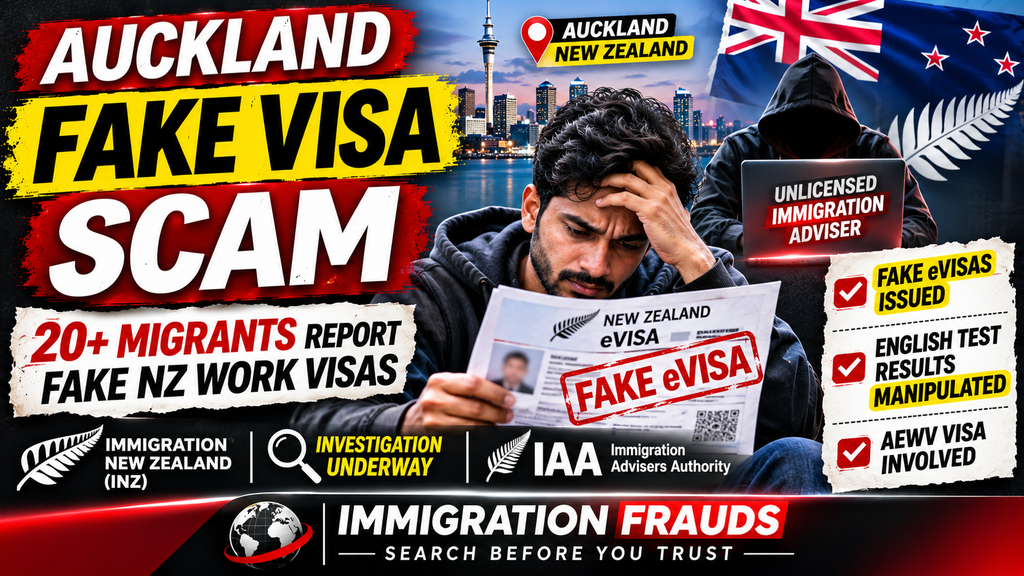
A major Auckland fake visa scam investigation has emerged in New Zealand after at least 20 migrants reportedly approached Immigration New Zealand (INZ), claiming that an immigration adviser had provided them with potentially fraudulent work visas. The allegations include fabricated electronic visa documents and the manipulation of English-language test results without applicants’ knowledge, raising serious concerns about the safety of migrants relying on unlicensed immigration professionals.
According to reporting by The New Zealand Herald, the cases involve New Zealand’s Accredited Employer Work Visa (AEWV), a temporary work visa that allows eligible migrants to work for accredited employers. Some applicants allegedly received fabricated eVisas that appeared genuine, while others may have had their visa applications supported by falsified English-language test scores.
Immigration New Zealand has confirmed that it is making inquiries into the allegations but has declined to disclose the total number of potentially affected migrants.
The Auckland fake visa scam allegations have also renewed concerns about unlicensed immigration advisers, the increasing sophistication of fraudulent visa documents and the financial vulnerability of migrants seeking overseas employment.
Auckland Fake Visa Scam: At Least 20 Migrants Approach Immigration New Zealand
The investigation reportedly began after migrants in Auckland discovered potential irregularities in the New Zealand visas arranged for them through an immigration adviser.
According to The New Zealand Herald, at least 20 people have approached Immigration New Zealand after allegedly discovering that their visa documents or supporting application information may not have been genuine.
The migrants reportedly believed that they had received legitimate immigration assistance and that their work visa applications had been handled correctly.
However, concerns emerged when some applicants discovered that their electronic visa documents might have been fabricated.
Other cases reportedly involved manipulated English-language test results, raising questions about whether applicants were aware of the information submitted on their behalf.
The allegations suggest that the suspected adviser may have operated in ways that left clients unaware of the potential irregularities in their own immigration applications.
For migrants who have invested substantial money and time in securing overseas employment, discovering that their visa documents may not be genuine can create serious uncertainty about their immigration status and future in New Zealand.
It is important to note that the reported 20-plus complaints do not mean that every individual has been confirmed as a victim of fraud. The investigation is ongoing, and the full extent of the alleged activity remains unknown.
Fake New Zealand Work Visas: How the Alleged Fraud Was Carried Out
One of the most concerning aspects of the Auckland fake visa scam investigation is the alleged use of different methods to mislead migrants.
According to the available reporting, the suspected irregularities fall into two main categories.
1. Fabricated electronic visas
Some migrants reportedly received electronic visa documents that appeared to be genuine New Zealand immigration approvals.
However, the documents were allegedly fabricated rather than issued through the official immigration system.
Because New Zealand visas are issued electronically, applicants often receive PDF documents as evidence of their immigration status.
The appearance of an official-looking document can make it difficult for someone without immigration expertise to identify inconsistencies.
2. Manipulation of English-language test results
Another allegation concerns the manipulation of English-language test scores.
Some New Zealand visa applications require applicants to demonstrate that they meet applicable English-language requirements.
According to the reporting, the adviser allegedly manipulated certain test results without the applicants’ knowledge.
Some applications supported by the allegedly falsified results were reportedly approved by immigration authorities.
This raises an important concern: migrants may believe their applications are genuine while information submitted on their behalf may contain false or misleading details.
The investigation will need to establish which documents were fabricated, which test results were manipulated and whether individual applicants knew about the alleged irregularities.
Accredited Employer Work Visa (AEWV) Under Investigation in Auckland Fake Visa Scam
The Auckland fake visa scam reportedly involves New Zealand’s Accredited Employer Work Visa, commonly known as the AEWV.
This visa allows eligible foreign workers to take employment with an employer accredited by Immigration New Zealand.
The scheme is an important pathway for overseas workers seeking employment opportunities in New Zealand.
Under the AEWV system, applicants must satisfy the relevant immigration requirements, while employers must meet applicable accreditation conditions.
The visa is temporary and may allow eligible migrants to work in New Zealand for periods of three to five years, depending on the applicable visa conditions and circumstances.
In the current investigation, the suspected adviser allegedly provided fabricated AEWV documents to some migrants.
Others reportedly had their applications supported by manipulated English-language test results.
The allegations are particularly concerning because an AEWV is connected to an individual’s employment and lawful immigration status.
A fraudulent document could potentially create serious difficulties when a migrant attempts to travel, begin employment, renew a visa or establish their immigration status with authorities.
However, the exact immigration status of the individuals involved has not been disclosed.
Immigration New Zealand Confirms Investigation Into Fake Visa Allegations
Immigration New Zealand has confirmed that it is making inquiries into the reported fake visa allegations.
Jason Perry, INZ’s national investigations manager, reportedly said the agency could not comment further because the matter was under active investigation.
The agency explained that discussing an ongoing investigation could compromise the integrity of the process and potentially affect the individuals involved.
INZ has not publicly disclosed how many migrants may ultimately be affected.
The investigation is expected to examine the suspected issuance of fabricated visa documents and the alleged manipulation of supporting information.
For the migrants who have approached immigration authorities, an important concern is determining whether their visas were genuinely issued and whether their immigration records contain inaccurate information.
The outcome of the investigation will help establish the scale of the alleged activity and the circumstances surrounding the affected applications.
Unlicensed Immigration Advisers: A Growing Concern for New Zealand Migrants
The Auckland fake visa scam has brought renewed attention to the problem of individuals providing immigration advice without the necessary authorisation.
New Zealand regulates immigration advice through the Immigration Advisers Authority (IAA).
Under the Immigration Advisers Licensing Act 2007, individuals generally need to hold a valid licence to provide New Zealand immigration advice unless they fall within a specific legal exemption.
This requirement also applies to people providing immigration advice from outside New Zealand, including individuals operating in countries such as India.
Certain people, including appropriately qualified New Zealand lawyers and other exempt individuals, may legally provide immigration advice without holding an IAA licence.
The purpose of the licensing framework is to ensure that people offering professional immigration advice meet the required standards and are subject to appropriate professional obligations.
However, migrants who are unfamiliar with New Zealand’s immigration system may struggle to distinguish between a genuine licensed professional and someone operating without authorisation.
Some individuals may also rely on personal recommendations, social media advertisements or promises of guaranteed visa approvals without checking the adviser’s credentials.
The current allegations demonstrate why independent verification is essential before trusting anyone with immigration applications, personal documents or large payments.
Immigration Adviser Complaints More Than Doubled in New Zealand
Official figures published by the Immigration Advisers Authority highlight an increase in complaints involving immigration advisers and unlicensed individuals.
According to the IAA’s annual statistics, complaints against licensed immigration advisers increased from 72 in the 2024–25 financial year to 143 in 2025–26.
The figures for complaints about unlicensed individuals also increased.
| Complaint category | 2024–25 | 2025–26 |
|---|---|---|
| Complaints against licensed advisers | 72 | 143 |
| Complaints about unlicensed individuals | 86 | 144 |
<em>Financial years run from July 1 to June 30.</em>
The latest figures cover July 1, 2025, to June 30, 2026.
The IAA also reported that during 2025–26:
- 143 complaints were received against licensed immigration advisers.
- 49 complaints were referred to the Immigration Advisers Complaints and Disciplinary Tribunal.
- 34 complaints were upheld by the Tribunal.
- 144 complaints were received about unlicensed individuals.
- Three prosecutions involving unlicensed persons were undertaken.
These statistics provide important context about the regulatory challenges surrounding immigration advice in New Zealand.
However, they should not be interpreted as proof that every complaint involves fraud or that every person complained about has committed an offence.
The figures relate to separate regulatory categories and do not establish any connection between the reported complaints and the specific Auckland investigation.
Nevertheless, the increase highlights the importance of checking an adviser’s professional credentials before engaging their services.
Immigration Lawyers Warn About Increasingly Sophisticated Fake Visa Documents
The Auckland fake visa scam allegations have also raised concerns among immigration professionals about the increasing sophistication of fraudulent documentation.
Immigration lawyer Alastair McClymont, who has reportedly worked in the sector for approximately three decades, told The New Zealand Herald that he was receiving complaints about fraudulent advisers and questionable visa documents more frequently than in the past.
He highlighted the vulnerability of migrants who pay substantial amounts to individuals promising to resolve their immigration problems.
According to the reporting, some migrants may only discover that their documents are questionable when they attempt to travel overseas or when their immigration status is examined.
Another immigration professional, Mahafrin Variava, an associate at law firm McVeagh Fleming, reportedly explained that some victims genuinely believed they had hired legitimate professionals.
She also highlighted how increasingly sophisticated technology can make fraudulent documents appear convincing.
This creates an additional challenge for migrants who may not have the technical knowledge or immigration expertise required to identify manipulated documents.
An electronic visa PDF may appear official at first glance, but its visual appearance alone cannot establish whether it was genuinely issued by Immigration New Zealand.
Fake eVisas Shared in Migrant Support Groups Raise Further Concerns
The investigation has also drawn attention to examples of suspected fake New Zealand eVisas reportedly shared within migrant support groups on Facebook.
According to The New Zealand Herald, immigration professionals examining one example identified inconsistencies in its presentation.
Mahafrin Variava reportedly highlighted differences in formatting and payment conditions that did not match the way Immigration New Zealand normally presents employment requirements in its visa documentation.
Such inconsistencies can be important warning signs.
However, migrants should not rely entirely on visual comparisons or social media discussions to determine whether a visa is genuine.
A document that looks professional may still be fraudulent, while differences in formatting do not automatically establish that an immigration document is fake.
The safest approach is to verify the visa directly through official Immigration New Zealand channels.
What Happens to Migrants Who Receive Fake New Zealand Visas?
One of the most serious concerns surrounding the Auckland fake visa scam is the potential impact on migrants who may have unknowingly received fraudulent documents.
The consequences can depend on the nature of the irregularity, the individual’s knowledge and involvement, the actual immigration record and the findings of Immigration New Zealand.
Potential difficulties may include:
Travel complications: A person carrying a fabricated eVisa may face problems when attempting to travel to New Zealand.
Uncertain immigration status: A document that appears to be an approval does not establish that a genuine visa has been granted.
Employment difficulties: Migrants may encounter problems when employers or authorities attempt to verify their work rights.
Financial losses: Applicants may lose money paid to an adviser for services or documents that were allegedly not genuine.
Future immigration concerns: False information submitted in an application can have serious implications for future immigration applications, depending on the circumstances.
It is important to understand that migrants who have been deceived by an adviser should not assume that their immigration position is automatically the same as that of the person who allegedly prepared fraudulent documents.
Anyone who suspects that their visa may be fake should contact Immigration New Zealand directly and seek independent legal advice.
They should not attempt to hide discrepancies or submit further documents without understanding their immigration position.
Key Takeaways: Auckland Fake Visa Scam Investigation
- At least 20 migrants in Auckland have reportedly approached Immigration New Zealand over allegedly fraudulent visa arrangements.
- The suspected adviser is alleged to have operated without the required immigration adviser licence.
- The cases involve New Zealand’s Accredited Employer Work Visa (AEWV).
- Some migrants reportedly received fabricated electronic visa documents.
- Other applications were allegedly supported by manipulated English-language test results.
- Some visas were reportedly approved based on the allegedly falsified test results.
- Immigration New Zealand has confirmed that it is investigating the allegations.
- INZ has not disclosed the total number of potentially affected migrants.
- The IAA recorded 143 complaints against licensed advisers and 144 complaints about unlicensed individuals in 2025–26.
- Immigration professionals have warned about increasingly sophisticated fake visa documents.
- Migrants are advised to verify their immigration adviser and visa directly through official New Zealand government channels.
FAQs : Auckland Fake Visa Scam
What is the Auckland fake visa scam?
The Auckland fake visa scam refers to allegations involving an unlicensed immigration adviser who reportedly provided fabricated New Zealand electronic visas and manipulated English-language test results for migrants. At least 20 people have reportedly approached Immigration New Zealand over the suspected irregularities.
How many migrants are reportedly affected by the Auckland fake visa scam?
At least 20 migrants have reportedly approached Immigration New Zealand. However, the authorities have not disclosed the final number of people potentially affected.
Which New Zealand visa is involved in the investigation of Auckland Fake Visa Scam?
The investigation reportedly concerns the Accredited Employer Work Visa (AEWV), which allows eligible foreign workers to work for accredited employers in New Zealand.
Were fake New Zealand eVisas allegedly issued in Auckland Fake Visa Scam?
Yes. According to the reporting, some applicants allegedly received fabricated electronic visa documents that appeared to be genuine Immigration New Zealand approvals.
Were English-language test results also manipulated in Auckland Fake Visa Scam?
The suspected adviser is alleged to have manipulated some applicants’ English-language test scores without their knowledge. Some applications supported by the allegedly falsified results were reportedly approved.
Has Immigration New Zealand confirmed the investigation in Auckland Fake Visa Scam?
Yes. Immigration New Zealand has confirmed that it is making inquiries into the allegations but has declined to provide further details because the investigation is ongoing.
What is the Immigration Advisers Authority in Auckland Fake Visa Scam?
The Immigration Advisers Authority is the New Zealand regulatory body responsible for licensing immigration advisers, maintaining professional standards, investigating unlicensed immigration advice and managing complaints.
Is it illegal to provide New Zealand immigration advice without a licence?
Generally, yes. Under the Immigration Advisers Licensing Act 2007, people providing New Zealand immigration advice must hold the required licence unless they qualify for a specific legal exemption.
How can migrants check whether their New Zealand visa is genuine?
Migrants can use Immigration New Zealand’s official Visa Verification Service to check whether their visa has been issued. They should also contact INZ directly if they suspect that their documents may have been fabricated.
What should someone do if an adviser has provided a fake visa?
The individual should contact Immigration New Zealand immediately, preserve all documents and payment records, and seek independent legal advice. They should not assume that an adviser-submitted document represents a genuine visa approval.
Are complaints against immigration advisers increasing in New Zealand?
Yes. IAA annual statistics show that complaints against licensed advisers increased from 72 in 2024–25 to 143 in 2025–26. Complaints about unlicensed individuals also increased from 86 to 144 during the same periods.
Final Takeaway On Auckland Fake Visa Scam
The Auckland fake visa scam investigation has exposed a serious concern for New Zealand’s migrant community: the possibility that people seeking legitimate overseas employment may unknowingly receive fabricated visa documents or have false information submitted in their immigration applications.
With at least 20 migrants reportedly approaching Immigration New Zealand, the investigation could have significant implications for people who relied on the suspected adviser’s services.
The alleged manipulation of English-language test results is particularly concerning because applicants may not realise that inaccurate information has been submitted in their names.
For migrants, the most important lesson is that an official-looking visa document is not proof of a genuine immigration approval.
Always verify your adviser, your employer and your visa through official government channels.
Source : NZ Today
Read About : Jalandhar Germany Job Fraud: Family Mortgages House to Pay ₹14 Lakh, 20-Year-Old Allegedly Sent to Greece Instead







One thought on “Auckland Fake Visa Scam: 20+ Migrants Reportedly Given Fake New Zealand Work Visas by Unlicensed Adviser”