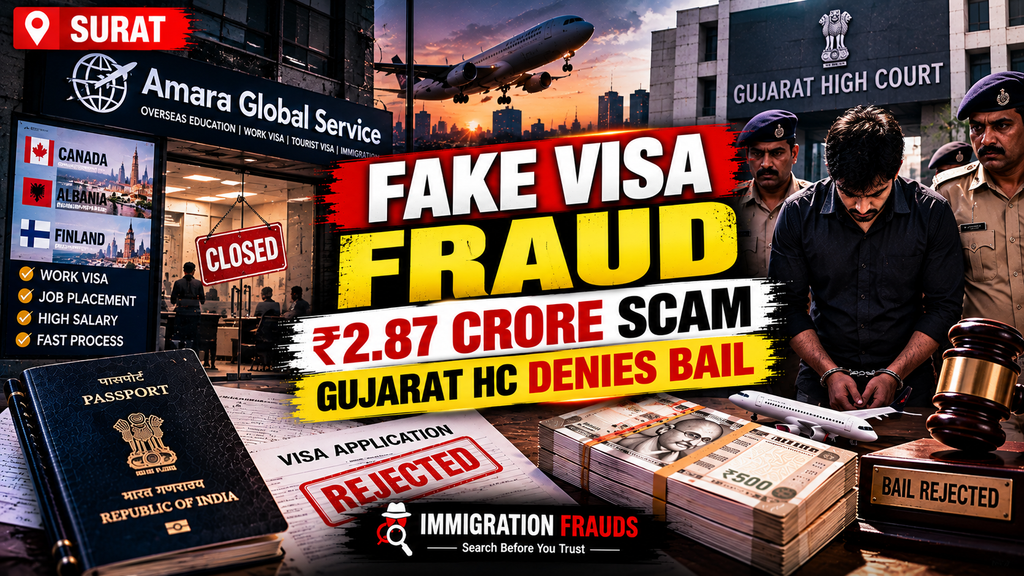
A 25-year-old man from Surat will remain in custody after the Gujarat High Court rejected his regular bail application in an alleged ₹2.87 crore visa fraud case involving promises of overseas visas and work permits. The destinations allegedly promised to prospective migrants included Canada, Albania and Finland.
According to the prosecution’s case, the accused allegedly contacted people through social media and mobile phones, collected money from individuals seeking opportunities abroad, and transferred funds to Delhi through the informal Angadia courier network.
The Gujarat High Court described the alleged offence as a serious white-collar socio-economic crime. However, the allegations remain subject to the legal process, and the rejection of bail does not amount to a conviction.
Surat Fake Visa Fraud: Key Details of the Case
The case was registered at Pal Police Station in Surat under provisions of the Bharatiya Nyaya Sanhita (BNS), 2023, and the Information Technology Act, 2000.
According to the prosecution, the accused allegedly presented himself as an agent capable of arranging overseas visas and work permits. Investigators alleged that he used multiple names, mobile phones and online contacts while dealing with prospective migrants.
Key details reported in the case include:
- ₹2,87,51,410: The total amount allegedly collected from 16 victims, according to the prosecution.
- ₹39.5 lakh: The amount reportedly received in an account associated with an entity called “PM Enterprise” and sent to Delhi through Angadia channels.
- Three countries: Canada, Albania and Finland were among the destinations allegedly promised.
- Multiple aliases: The accused allegedly used names including Akshit, Raj, Rocky Patel and Ashok Patel.
- Bail rejected: The Gujarat High Court declined his request for regular bail.
- Two co-accused: Rohan Patel and Zakir, also known as Chaudhary, were reported to be at large when the court considered the application.
These details form the central elements of the reported Surat fake visa fraud case. The amounts and roles described above reflect the prosecution’s allegations and the material recorded in the court order.
How the Alleged Visa Scam Operated
According to the prosecution’s account recorded by the High Court, the accused allegedly approached people interested in travelling abroad for employment and promised to arrange the necessary visas and work permits.
Social media platforms and mobile phones were reportedly used to connect with potential clients. The alleged destinations included Canada, Albania and Finland, countries where prospective migrants may seek employment and better career opportunities.
The prosecution alleged that money collected from victims was transferred to Delhi through Angadia couriers rather than being routed entirely through conventional bank-account transactions.
The Angadia system is an informal channel used in India to transport money and valuables between locations. In this case, investigators reportedly recovered Angadia slips and recorded statements from individuals associated with the transfers.
The court considered this material while assessing the defence argument that there was no conventional banking trail directly linking the accused to the alleged transactions.
The Surat fake visa fraud investigation therefore involved not only the alleged promises made to applicants but also the methods used to transfer the money.
Albanian Embassy Reportedly Identified a Visa Document as Fake
An important detail recorded in the court order concerned a visa document allegedly used during the transactions.
According to the prosecution, an opinion from the Albanian embassy indicated that the document in question was fake. This formed part of the material relied upon by the prosecution while opposing bail.
The case also allegedly involved multiple mobile phones, different IP addresses and the use of a Google link. Investigators reportedly found evidence of a common IP address and email connection that, according to the prosecution, suggested coordination between the accused and other individuals involved in the case.
These allegations were considered alongside the reported financial transactions and statements collected during the investigation.
The Surat fake visa fraud allegations underline why applicants should independently verify visa documents and never rely solely on copies or assurances supplied by an intermediary.
₹39.5 Lakh Linked to PM Enterprise
The High Court’s order also referred to 23 alleged clients who had received visa-related services through an entity called “PM Enterprise”.
According to the material recorded in the order, ₹39.5 lakh was received in an account associated with the entity and then sent to Delhi through Angadia channels.
This figure is separate from the prosecution’s allegation that ₹2,87,51,410 was collected from 16 victims in the overall case. The available report does not establish that the two figures represent separate, non-overlapping losses, so they should not be added together.
The court considered the available material while evaluating the alleged role of the applicant and the seriousness of the case.
For people considering overseas employment, the Surat fake visa fraud case is a reminder to check the identity of the person or business receiving money, understand the services being offered and keep records of every transaction.
Why the Gujarat High Court Rejected Bail
Justice Hasmukh D. Suthar rejected the accused’s regular bail application after considering the prosecution’s allegations and the defence submissions.
The defence argued that the accused had been falsely implicated and that the allegations primarily concerned co-accused Rohan Patel, who was reportedly absconding. The defence also submitted that the investigation had been completed, the chargesheet had been filed and no further recovery from the applicant was required.
The defence further pointed to bail granted to another co-accused, Varun Parmar, and argued that there was no conventional bank-account trail showing the alleged transactions.
However, the High Court considered the applicant’s alleged role to be more serious than that of the co-accused who had received bail. The court also questioned the earlier decision to grant bail to that individual, observing that the material on record had not been properly considered.
On the financial trail argument, the court referred to the recovered Angadia slips and statements recorded from Angadia operators. It noted that, because the alleged transfers were made through a private channel, the absence of transactions in the applicant’s bank account did not by itself resolve the issue.
The court also considered the seriousness of the charges, the presence of co-accused who remained at large, and the potential risks of evidence tampering or flight.
The Surat fake visa fraud case was described as a serious white-collar socio-economic offence requiring a careful approach when considering bail.
What Is Section 316(5) of the Bharatiya Nyaya Sanhita?
The court order noted that Section 316(5) of the Bharatiya Nyaya Sanhita was added during the investigation. The provision concerns an aggravated form of criminal breach of trust and carries a potential punishment of life imprisonment.
The court referred to the seriousness of the provision when considering the bail application.
The inclusion of a particular legal provision does not itself establish guilt. The prosecution must prove the relevant allegations through the legal process, and the accused retains the right to defend himself.
In the reported Surat fake visa fraud case, the High Court’s decision concerned whether the accused should be released on bail at that stage—not whether he had been finally convicted.
Four Similar Cases and Multiple Aliases Cited by Prosecution
The prosecution also submitted that the accused had been involved in four similar cases in the past and had allegedly used several names, including Akshit, Raj, Rocky Patel and Ashok Patel.
Investigators reportedly used technical surveillance to track him after he allegedly moved between locations. The prosecution further stated that he had been in contact with co-accused Rohan Patel and Zakir alias Chaudhary, who had not been arrested at the time of the hearing.
These were prosecution submissions considered during the bail proceedings. The existence of allegations or other cases should not be treated as proof of guilt in the present matter.
The High Court ultimately rejected the bail plea, citing the overall circumstances, the seriousness of the alleged offence and concerns about the possible misuse of liberty.
How to Protect Yourself From Fake Visa and Overseas Job Offers
The reported case highlights practical precautions that overseas job seekers should take before paying an agent.
- Verify the agent’s credentials. Check the relevant registration or authorisation and confirm the identity of the person or company offering assistance.
- Verify the employer independently. Contact the overseas employer through reliable, independently obtained details rather than relying only on an agent’s messages.
- Check visa documents. Use the destination country’s official immigration resources or appropriate official channels to understand the visa process and verify documents.
- Get a written agreement. Confirm the services, total fees, refund terms and responsibilities in writing before making payment.
- Keep payment records. Retain receipts, bank records, messages, advertisements and copies of submitted documents.
- Be cautious about informal transfers. Understand who is receiving the money, why the payment is being requested and whether a verifiable receipt is available.
- Report suspected fraud promptly. Preserve evidence and approach the relevant police or authorities if you believe you have been deceived.
The Surat fake visa fraud case shows why applicants should treat claims of guaranteed visas or overseas work permits with caution and independently verify every important detail.
FAQs : Surat Fake Visa Fraud
1. What is the Surat fake visa fraud case about?
The case involves allegations that a 25-year-old Surat man collected money from people by promising overseas visas and work permits, including for Canada, Albania and Finland. The prosecution alleges that ₹2.87 crore was collected from 16 victims.
2. How much money was allegedly involved in Surat Fake Visa Fraud?
The prosecution cited a total of ₹2,87,51,410 allegedly collected from 16 victims. The High Court’s order also referred separately to ₹39.5 lakh received through an entity called PM Enterprise and transferred to Delhi through Angadia channels.
3. Why did the Gujarat High Court reject bail?
The court considered the alleged seriousness of the offence, the applicant’s role as described by the prosecution, evidence relating to Angadia transfers, the status of co-accused and potential risks involving flight or interference with evidence.
4. What is the Angadia network?
Angadia is an informal system used in India to transport money and valuables. In this case, the prosecution alleged that money collected from victims was sent to Delhi through this network.
5. Which countries were allegedly promised to victims in Surat Fake Visa Fraud?
The prosecution said that Canada, Albania and Finland were among the destinations offered to prospective migrants.
6. Has the accused been convicted?
The report concerns the rejection of a bail application. It does not report a final conviction in the case, and the allegations must be determined through the legal process.
7. How can applicants avoid fake visa scams?
Applicants should verify agents and employers independently, confirm visa requirements through official sources, obtain written contracts, retain payment receipts and avoid relying solely on social media promises.
Key Takeaway On Surat Fake Visa Fraud
The Surat fake visa fraud case involves allegations of ₹2.87 crore collected from 16 victims through promises of overseas visas and work permits. The Gujarat High Court rejected the accused’s regular bail plea, citing the seriousness of the alleged white-collar offence and the material presented during the proceedings.
The decision is a bail ruling, not a final determination of guilt. For aspiring migrants, the key lesson is to verify agents, employers and visa documents independently before transferring money.
Source : The Indian Express
Read About : Gopalganj Visa Fraud: 250 People Allegedly Cheated of Over ₹3 Crore