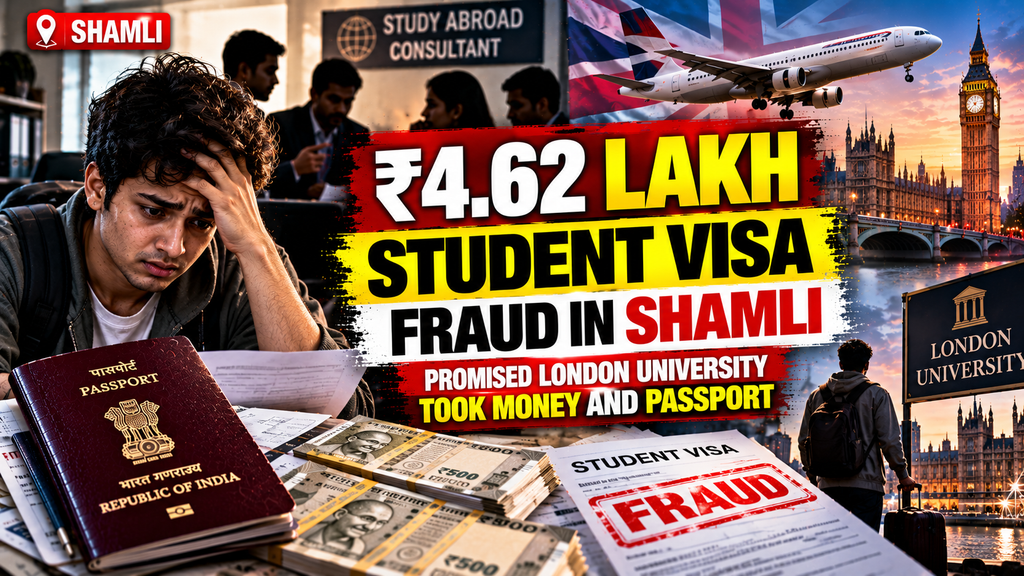
A student from Haridwar district has allegedly been cheated of ₹4.62 lakh after being promised admission to a university in London and a student visa for pursuing a master’s degree in the UK. Police in Jhinjhana, Shamli, have registered an FIR against four people following the student’s complaint.
The case has raised fresh concerns about overseas education scams in western Uttar Pradesh, where students and families can be exposed to financial losses after trusting informal education agents or intermediaries.
The Shamli student visa fraud case involves allegations that ₹2.62 lakh was transferred through UPI, while another ₹2 lakh was allegedly paid in cash. The complainant also alleges that his passport was taken and was not returned for around five months.
According to the complaint, the student was allegedly promised admission to a London university for a master’s programme and assistance with obtaining a student visa. Police have registered a case against Naushad, Shadab, Maha and Hayat, and an investigation is underway.
The allegations have not been established as proven facts, and the police investigation will determine the circumstances surrounding the money, passport and proposed UK study arrangements.
What Happened in the Shamli Student Visa Fraud Case?
The complainant, identified as Jenis Alam, is a resident of Padli Gujjar village in the Ganganahar police station area of Haridwar.
According to his complaint, Alam met Kairana residents Naushad and Shadab while studying at Roorkee University.
The two allegedly told him that they could help him obtain admission to a university in London for a master’s degree and arrange a student visa.
The Shamli student visa fraud complaint alleges that Alam was subsequently taken to Naushad’s residence after being told that approximately ₹10 lakh would be required for the visa and education-related process.
There, Naushad and his wife Maha allegedly explained the proposed process to him.
According to the complaint, Alam subsequently transferred ₹2.62 lakh through UPI to Naushad’s bank account.
The complainant further alleges that Naushad, Shadab and Hayat later took his passport along with ₹2 lakh in cash.
₹4.62 Lakh Allegedly Paid Through UPI and Cash
The financial component is one of the central issues in the Shamli student visa fraud investigation.
According to the complaint:
- ₹2.62 lakh was allegedly transferred through UPI.
- ₹2 lakh was allegedly paid in cash.
- The total amount allegedly involved was ₹4.62 lakh.
- The payment was allegedly connected with the proposed London university admission and student visa process.
The complainant says that despite the passage of approximately five months, neither the money nor his passport was returned.
Police are expected to examine bank and UPI records as part of the investigation to determine the movement of the alleged ₹2.62 lakh payment.
Cash payments, meanwhile, may require investigators to examine statements and other supporting evidence to establish when and how the alleged transaction took place.
Student Allegedly Promised a London Master’s Degree
The alleged scheme was reportedly presented as an opportunity to study for a master’s degree at a London university.
For students, studying in the UK can involve substantial costs, including tuition, accommodation, travel, visa-related expenses and living costs.
This makes verification particularly important before making payments to an intermediary.
In the Shamli student visa fraud complaint, the student allegedly believed that the people involved could help arrange the overseas education process.
However, the complaint alleges that after money and the passport were handed over, the promised process did not result in the student’s passport or money being returned.
The available report does not establish whether a genuine university application was submitted, whether an admission offer was issued or whether a formal UK student visa application was actually filed.
Those details will have to be established during the investigation.
Passport Allegedly Taken and Not Returned for Five Months
Another major allegation in the Shamli student visa fraud case concerns the student’s passport.
According to the complaint, the passport was allegedly taken along with ₹2 lakh in cash by Naushad, Shadab and Hayat.
The complainant says that around five months later, the passport had still not been returned.
A passport is a critical identity and travel document, and students planning to travel abroad should be particularly cautious about handing over original documents to intermediaries.
Applicants should understand why an original document is being requested, who is holding it and when it will be returned.
They should also retain clear copies or scans of their passport and all other documents.
Threat Allegations Made When Money and Passport Were Demanded Back
The complaint contains another serious allegation.
According to the report, when Alam allegedly asked for his money and passport back, he accused Naushad and Hayat of threatening to kill him and falsely implicate him in a case. (amarujala.com)
These are allegations made by the complainant and have not been independently established in court.
Police will need to investigate the alleged threats along with the financial transaction and passport-related allegations.
If investigators obtain supporting evidence, those findings could form part of further legal proceedings.
Four People Named in the FIR
Police have registered the case against four people named in the complaint:
| Name | Information reported |
|---|---|
| Naushad | Resident of Kairana; allegedly involved in the proposed visa and education process |
| Shadab | Resident of Kairana; named in the complaint |
| Maha | Naushad’s wife; allegedly explained the process to the complainant |
| Hayat | Named in the complaint and allegedly involved in taking the passport and cash |
The allegations against these individuals remain subject to investigation.
The registration of an FIR does not mean that the accused have been convicted or that every allegation has been legally established.
Police Begin Investigation Into the Alleged Visa Scam
According to Shamli police, an FIR was registered on the basis of the complaint and the investigation has begun.
Superintendent of Police Narendra Pratap Singh advised people to conduct proper checks before giving money to anyone for overseas education or employment.
The advice includes verifying the agent, company, university and visa information before making payments.
Police also advised applicants not to hand over original passports to unknown individuals and to preserve receipts and other documents related to payments.
The Shamli student visa fraud investigation is expected to establish whether a genuine admission or visa process was initiated and what happened to the money allegedly paid by the student.
How Students Can Verify a UK Student Visa Agent
The Shamli student visa fraud allegations underline why students should not rely solely on verbal promises when planning to study overseas.
Before paying an education consultant, students should independently verify:
The university
Check whether the university and course actually exist and whether the institution is authorised to enrol international students.
Students should use official university websites and contact the institution directly where necessary.
The admission offer
An offer letter should be independently verified with the university.
Do not assume that a PDF or printed letter is genuine simply because it contains a university logo or professional formatting.
The visa process
Understand exactly which UK visa route is being proposed and what documentation is required.
Students should obtain information directly from official UK government sources rather than relying entirely on an agent.
The consultant
Ask for the consultant’s full business details, office address, receipts and written agreement.
Avoid handing over large sums without documentation explaining what the payment is for.
Why Students Should Be Careful With Large Upfront Payments
A major warning sign in the Shamli student visa fraud case is the alleged payment of ₹4.62 lakh before the student received the promised outcome.
A large upfront payment does not automatically mean an agent is fraudulent. Genuine overseas education processes can involve substantial fees.
However, students should clearly understand:
- How much is university tuition
- How much is the visa fee
- How much is accommodation
- What the consultant’s service fee is
- Which payments are refundable
- Who receives each payment
- Whether the payment is made to the university or an intermediary
- What documentation is provided as proof
Whenever possible, students should make university and government payments through official channels rather than transferring large amounts to an individual’s personal account.
Previous Overseas Fraud Allegations Reported in Shamli
The latest case is not the only overseas-related fraud allegation reported in the Shamli region.
According to the same report, earlier allegations included a case in April 2025 involving ₹5 lakh allegedly taken from a Kandhla youth for a Singapore hotel-management course.
In July 2025, a resident of the Jhinjhana area allegedly accused three people of taking ₹35 lakh on the promise of arranging employment for his son in the United States.
In January 2026, several people were allegedly accused of taking ₹26 lakh on the promise of arranging overseas employment.
More recently, in September 2026, a resident of Babri allegedly accused three people of taking ₹25 lakh on the promise of sending his son to New Zealand on a valid work visa.
These are separate cases and allegations, and they should not be treated as evidence that the same individuals or organisations were involved.
However, the repeated reports demonstrate the importance of verifying overseas education and employment offers before paying money.
What Should You Do Before Paying for Overseas Education?
The Shamli student visa fraud case provides several practical lessons for students and parents.
1. Verify the university directly.
Contact the institution using details published on its official website.
2. Verify the admission offer.
Do not rely solely on documents supplied by an agent.
3. Understand the complete fee structure.
Ask for an itemised breakdown before making payments.
4. Avoid unexplained cash payments.
Use traceable payment methods wherever possible.
5. Keep payment evidence.
Save UPI receipts, bank statements and invoices.
6. Protect your passport.
Do not hand over the original passport to an unknown person without a legitimate and documented reason.
7. Get a written agreement.
Make sure the services and refund terms are clearly recorded.
8. Verify the visa process independently.
Do not rely entirely on an intermediary’s explanation.
9. Be cautious about guaranteed outcomes.
No consultant should make unrealistic promises about visa approval.
10. Report suspicious activity quickly.
If money or documents have been taken and the promised service is not being delivered, preserve evidence and approach the police or relevant authorities.
What Evidence Should a Student Keep?
If a student suspects an overseas education scam, they should preserve all available evidence.
This may include:
- WhatsApp conversations
- Phone numbers
- Emails
- Social-media advertisements
- University offer letters
- Application forms
- Visa documents
- UPI payment receipts
- Bank statements
- Cash-payment acknowledgements
- Agreements
- Consultant details
- Passport-related communications
- Screenshots
- Audio or video evidence
In the Shamli student visa fraud case, such records could help investigators establish the sequence of events and trace the alleged payments.
Students should avoid deleting messages or documents after a dispute begins.
Shamli Student Visa Fraud: Key Facts at a Glance
| Detail | Information |
|---|---|
| Location | Jhinjhana, Shamli, Uttar Pradesh |
| Complainant | Jenis Alam |
| Residence | Padli Gujjar, Haridwar district |
| Proposed destination | London, United Kingdom |
| Proposed purpose | Master’s degree |
| Alleged total amount | ₹4.62 lakh |
| Alleged UPI payment | ₹2.62 lakh |
| Alleged cash payment | ₹2 lakh |
| Passport | Allegedly taken and not returned |
| Period mentioned | Around five months |
| FIR | Registered against four people |
| People named | Naushad, Shadab, Maha and Hayat |
| Current status | Police investigation underway |
The information above is based on the police complaint and media report. Allegations against the named individuals have not been established as convictions.
FAQs : Shamli Student Visa Fraud
What is the Shamli student visa fraud case?
The Shamli student visa fraud case involves allegations that a student was cheated of ₹4.62 lakh after being promised admission to a London university and assistance in obtaining a UK student visa. Police have registered an FIR against four people and begun an investigation.
How much money was allegedly taken?
The complainant alleges that ₹2.62 lakh was transferred through UPI and ₹2 lakh was paid in cash, bringing the alleged total to ₹4.62 lakh.
Who is the complainant?
The complainant is identified as Jenis Alam, a resident of Padli Gujjar village in the Ganganahar police station area of Haridwar.
Which country was the student allegedly promised admission to?
According to the complaint, the student was promised admission to a university in London, UK, for a master’s degree.
Who has been named in the FIR?
Police registered the case against Naushad, Shadab, Maha and Hayat, according to the report.
Was the student actually issued a UK student visa?
The available report does not establish that a genuine UK student visa was issued. The police investigation will need to establish what, if any, visa or university application process was initiated.
Was the passport allegedly taken?
Yes. The complaint alleges that the student’s passport was taken along with ₹2 lakh in cash and was not returned for approximately five months.
What should students check before paying an overseas education agent?
Students should independently verify the university, admission offer, visa route, consultant’s credentials, payment details and refund terms. They should also retain receipts and copies of all documents.
Is the Shamli student visa fraud case proven?
No. An FIR represents the beginning of a criminal investigation. The allegations against the named individuals have not been established as proven facts by a court.
Key Takeaway On Shamli Student Visa Fraud
The Shamli student visa fraud case is a warning for students and families planning to study abroad: never rely solely on an agent’s promise of admission or a student visa before making a substantial payment.
The alleged ₹4.62 lakh loss included ₹2.62 lakh transferred through UPI and ₹2 lakh in cash, while the complainant also alleges that his passport was taken and not returned for around five months.
Students should independently verify the university, admission offer and visa process, maintain complete payment records, avoid unexplained cash transactions and be extremely careful about handing over original passports.
The FIR against four people is now under investigation, and the facts of the case will ultimately depend on the evidence collected by police and any subsequent legal proceedings.
Source : Amar Ujala
Read About : Punjab Canada Immigration Scam 2026 : AI Used to Impersonate Officials and Promise Guaranteed Jobs